More physical activity in schools with sportstation²
Run a course, discover your result and try again: sportstation² combines real movement with digital play. Explore ideas for PE lessons, active breaks and after-school activities.
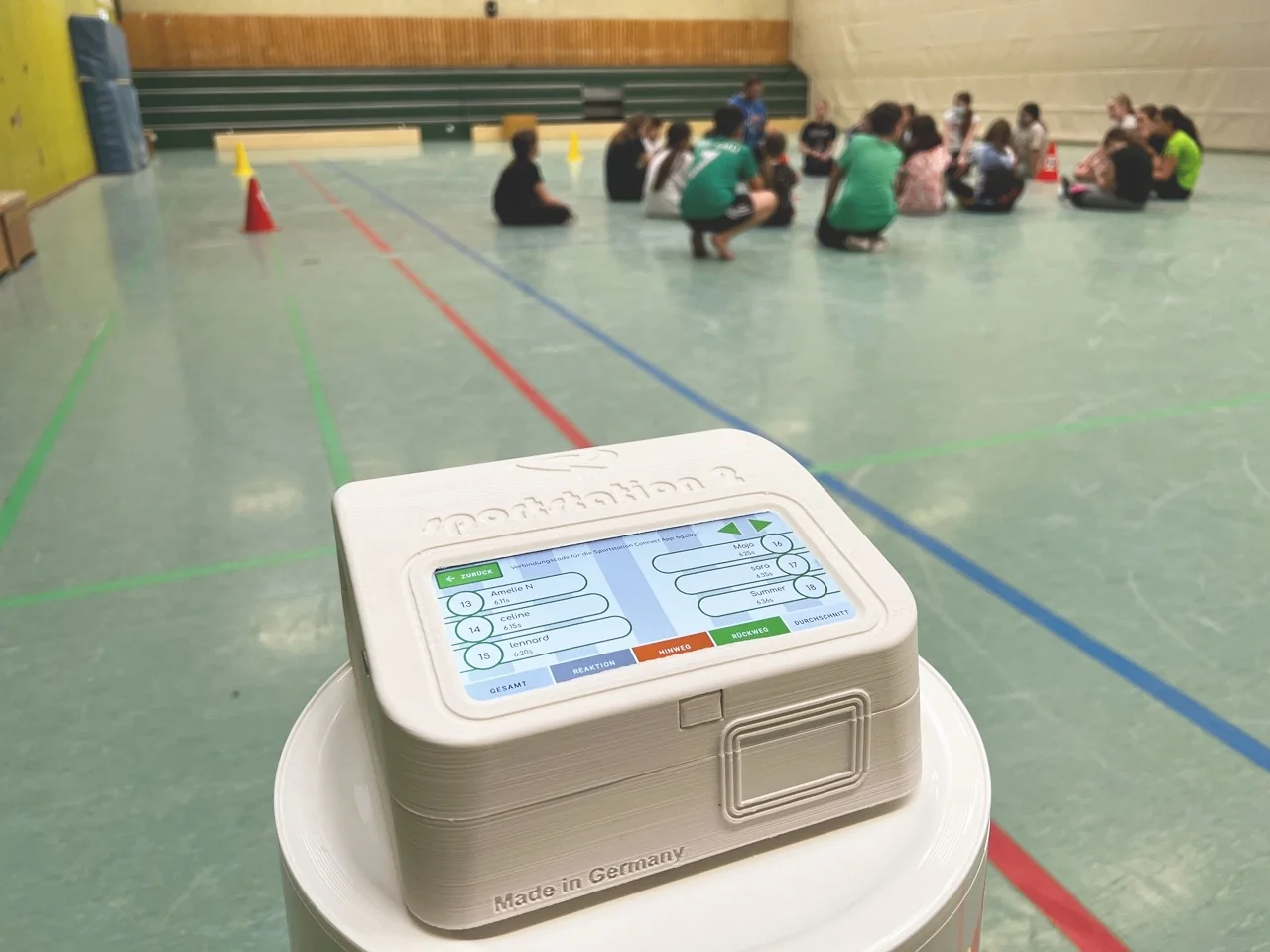
sportstation² at school · Project archive photograph.
Encouraging movement throughout the school day
A short course can become a PE station, a supervised break activity or a regular part of an after-school club. Choose tasks that suit the group, allow enough space and plan supervision and clear rules.
sportstation² is a mobile sports console with a battery. Children run, dribble or bounce a ball through a course; the console measures movement and displays results. A personal NFC wristband links attempts to a profile. Stars and personal bests provide goals for another attempt. Available games and unlocks depend on the game and package.
School leaders, teachers and after-school teams can plan together: who will use the equipment, where will it be set up and who will supervise?
Four ways to use sportstation² at school
Primary school PE
Use a cone course as one station in a lesson. Let children practise before a timed attempt. Teachers choose distances and difficulty and observe movement quality. Try running first, followed by dribbling or bouncing a ball; safe movement and ball control take priority over speed.
A supervised course gives children a place to play during a break. Short rounds, a separate waiting area and clear turn-taking help organise the activity. Children can repeat their own time or try to match a target time. Check the surface, safe routes and local conditions before use.
A regular activity club allows time to learn the games and practise. Build the course together, explain the task, take turns in small groups and discuss the attempts afterwards. Repeated sessions give children opportunities to pursue their own goals.
Include a speed challenge or target-time game as one sports-day station. Agree on comparable routes, rules and numbers of attempts. Teachers can organise class scores and team tasks; this does not imply automatic class scoring or tournament management.
The shortest valid time wins. Running and dribbling tasks provide opportunities to practise speed. Linear sprints with separate start and finish points require two devices.
Time perception
In Genau Joggen, players try to match a target time as closely as possible. For example, a teacher can set a 20-second task where the fastest attempt is not the winning one.
Consistency
In Paesen, the aim is the smallest possible difference between outward and return times. The task encourages attention to an even pace.
Practising coordination, reaction and speed through play
Teachers can include changes of direction, dribbling or bouncing a ball to practise coordination. Starting tasks offer opportunities to react to signals; depending on the game, results can show reaction and sprint information. The device does not automatically assess ball-control quality or a child’s coordination development.
Choose suitable tasks, allow repeated attempts and discuss feedback together. These activities do not guarantee a training or learning outcome. Adapt distances, difficulty and rest to the group.
Motivation through playful challenges
A personal best, stars or a new level can provide the next goal. Children can compare their own attempts as well as compete with others. Alternate between speed, time perception and consistency.
The optional Connect app adds an avatar, statistics, personal bests, history and rankings. Games and results are available on the console itself. Compare similar games, distances and conditions, and clarify how personal profiles and the app will be used at your school.
Consider your space, supervision and intended tasks. sportstation² adds measurement, personal profiles and digital play incentives to physical activity courses.
Will you use it in lessons, breaks, clubs or occasional events?
Which games, wristbands and additional devices are needed?
Who will set up, charge, store and supervise the equipment?
What purchase costs and any ongoing costs apply to your chosen package?
Tell Alexander Paes which age groups you work with and whether you are planning lessons, active breaks or after-school activities. Discuss equipment, organisation and a suitable offer.